Repeats and form
Repeat barlines
Section titled “Repeat barlines”Select a block of measures and press r.
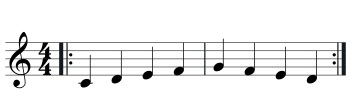
The same block again removes them, and undo restores whatever barline the repeat overwrote — a double bar you had there survives the round trip.
Volta brackets
Section titled “Volta brackets”With a block selected, shift + 1…9 toggles that ending number on the bracket over those measures.
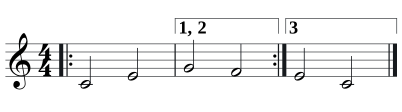
Numbers build up into sets: press shift + 1 then
shift + 2 on the same block and you get 1, 2. Removing
the last number removes the bracket. A block that would cross an existing ending
is refused.
Closing barlines are renormalised across the whole bracket group automatically: every bracket that has a later sibling ends with a repeat barline, the last one ends with a double barline — unless it closes the score, whose final barline is left as it is.
In edit view each measure draws its own segment of the bracket; page view shows the true spanning bracket.
Segno, coda, fine, D.S. and D.C.
Section titled “Segno, coda, fine, D.S. and D.C.”o cycles the whole repeat-mark family on the target:
coda sign → To Coda → segno → fine → D.S. → D.C. → off
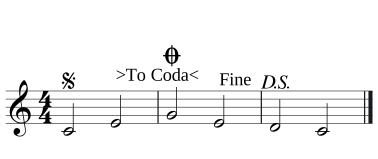
The two coda marks are worth a word, because MEI encodes both the same way and battuta distinguishes them by their text: the coda sign is the destination, and To Coda is the jump-out marker. Written as a pair they behave like the real thing — a D.S. or D.C. recap that reaches To Coda jumps to the sign. Either mark on its own is decorative.
Playback follows the form
Section titled “Playback follows the form”This is the part that makes the notation worth writing: press play and the score takes the route you notated.
- Plain repeat barlines are taken.
- Voltas are honoured, including number sets like
[1, 2][3]— the repeat passes take their own endings, and the recap takes only the final ending. - One dal-segno or da-capo jump is followed, with fine and To Coda respected. The first pass stops at the jump mark rather than running to the end, so a mid-score D.C. sounds like a mid-score D.C.; the material after it plays only when a To Coda jump leads there.
- The loop-back target is the repeat sign when there is one, otherwise the top of the score.
- Repeated passes light up the same notes you wrote, because every repeated copy is mapped back to its notated element for the highlight.
Exotic forms battuta cannot resolve are played unexpanded — straight through, once — rather than guessed at.
See Playback for the player itself.
All repeat bindings
Section titled “All repeat bindings”| Keys | Action | Applies |
|---|---|---|
| ' | simile slash (one beat) | any time |
| " | measure repeat % → %% | any time |
| r | repeat barlines 𝄆 𝄇 | block selection |
| ⇧1–9 | volta number toggle | block selection · physical digitsfixed |