
Status bar reference
The status bar is battuta’s control panel: state on the left, context on the right. Every select shows the value in force at the caret and applies its change at the caret’s measure.

Left: what state am I in?
Section titled “Left: what state am I in?”INPUT (i)
Section titled “INPUT (i)”Grey when note input is off. Click it, or press i, to turn input on; it turns green and becomes a live duration readout.

The readout is 1/8 ♪ (4):
| Part | Means |
|---|---|
1/8 |
The duration you are about to write (2/1 for a breve) |
♪ |
Its note glyph, with the dot if one is active |
(4) |
The digit key that selects this duration |
Caret readout
Section titled “Caret readout”[ m 10, s 2, v 1, n 6 ] — measure, staff, voice, and the index of the event
under the caret, all counted from 1. [ — ] means there is no caret; click a note
to place one.
Right: context and tools
Section titled “Right: context and tools”staves
Section titled “staves”Shows the staff count. Operations:
- add staff below — appends a treble staff with whole-measure rests in every measure, and moves the caret there.
- remove caret staff — removes the caret’s staff from the entire score. The last staff is refused.
voices
Section titled “voices”Shows the caret’s voice. Operations: switch to any voice of the caret’s staff, add a voice (from the caret’s measure onward), remove this voice (from the caret’s measure onward). A staff’s last voice is refused.
harmony
Section titled “harmony”Opens an annotation lane at the caret:
- chord symbols — above the staff
- roman numerals — below the staff
See Harmony lanes.
Staff-local. Stepping onto another staff updates the indicator.
| Option | Clef |
|---|---|
| 𝄞 treble | G clef on line 2 |
| 𝄢 bass | F clef on line 4 |
| 𝄡 alto | C clef on line 3 |
| 𝄡 tenor | C clef on line 4 |
| 𝄞 octave down | Treble, sounding an octave lower |
A clef battuta doesn’t offer but finds in your file is displayed as it is, and stays untouched unless you change it.
Score-wide from the caret’s measure onward: 7♭ … 1♭, ♮ (0), 1♯ … 7♯.
Score-wide from the caret’s measure onward: 4/4, 3/4, 2/4, 2/2, 3/2, 6/8, 9/8, 12/8, 5/4, 7/8, 5/8, 3/8. A meter already in your file that isn’t on the list is shown and preserved.
A meter change is validated against every measure up to the next meter change and refused — naming the first measure that no longer fits — if existing content would become invalid. Whole-measure rests always fit.
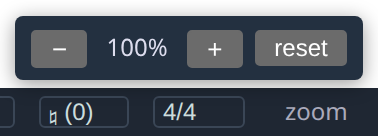
Click for + / − / reset: 50 % to 250 % in 25 % steps. Also ctrl + + / − / 0. Remembered between sessions.
| Reads | Means |
|---|---|
MIDI >< grey |
No controller connected |
MIDI <> green, with a count |
Controllers connected — click to list them |
Devices hot-plug, so the indicator follows what you plug in while battuta runs.
The header’s performance numbers
Section titled “The header’s performance numbers”The ⏱ button in the header shows or hides render timings — per-tile milliseconds, cache statistics, edit latency. They are diagnostics, off by default; turn them on if you want to see why something felt slow, or to include numbers in a bug report.