How battuta thinks
Three ideas explain nearly everything battuta does, including the things it refuses to do. Ten minutes here saves an hour of surprise later.
1. The document is the truth
Section titled “1. The document is the truth”battuta does not have an internal drawing that it exports as MEI. It has your MEI file, parsed into a tree, and everything on screen is a projection of that tree. Saving is a serialisation of the same thing you have been editing.
Consequences you can feel:
- Nothing is lost in the round trip. Elements battuta doesn’t understand,
attributes it has no UI for, comments, processing instructions, the whole
meiHead— all preserved verbatim and written back out. Files from other tools come back recognisably themselves. - Every element has an
xml:id, generated on import if missing. Ids are the currency of the whole editor: the caret is an id, a selection is a set of ids, hit-testing a click means finding the id of the SVG element you hit. - What you save is readable. Saves are pretty-printed with two-space indentation, and elements with text content stay on one line, so mixed content is untouched. You can diff two saves in git and see the edit.
2. Every edit is a reversible command
Section titled “2. Every edit is a reversible command”There is no “modify the document” path. Each action builds a command object that knows how to apply itself and how to revert itself, and the undo stack holds those commands.
- An action that touches several places is one undo step. Dotting a note that has to steal time from following rests: one step. Wrapping six notes in a sextuplet and writing the freed rests after it: one step. Regenerating every id in the document: one step.
- Revert is byte-identical. This is tested by a property fuzzer that applies random commands and checks that undoing returns the exact original bytes — it is the strongest guarantee in the codebase, not an aspiration.
- Undo is instant even in large scores, because undoing is a model change plus a tile swap, not a re-render of everything.
3. Measures have to add up
Section titled “3. Measures have to add up”In MEI, the events in a voice must sum to the measure’s notated duration. That rule is not advisory in battuta: it is enforced at the point of every edit.
This is why note entry is an overwrite mode rather than an insert mode. Writing an eighth where a quarter was fills the leftover with rests; writing a half note consumes the events after it. The measure’s total never changes, so the document is never briefly invalid.
Why an edit gets refused
Section titled “Why an edit gets refused”When an edit cannot keep the arithmetic true, battuta refuses it and says why in a toast. Common ones, and what to do:
| Refusal | Why | What to do |
|---|---|---|
| Entry stops at a boundary | A longer note would have to eat across a beam, a tuplet, or the barline | Shorten the note, or clear the obstacle first |
| Meter change refused, naming a measure | Existing content in that measure no longer fits the new meter | Fix that measure, or change the meter on empty/whole-rest measures |
| Merge refused | The two durations don’t add up to something writable (a half plus an eighth has no single notehead) | Use a tie instead |
| Tuplet refused | Wrong number of notes, a non-consecutive run, or freed time that can’t be written as rests | Select exactly 3 or 6 consecutive equal notes |
| Paste refused | The fragment’s duration doesn’t fit the target under the paste policy | Match the shapes, or paste into measures you’re willing to replace wholesale |
| Retrograde skipped | Chord sizes don’t mirror, so pitch content can’t be reversed onto the rhythm | Reflect a passage whose chord shape is symmetric |
A refusal never leaves a half-applied edit behind. If an operation wraps another one — an auto-unbeam before a rhythm change, say — and the inner edit refuses, the wrapper rolls back too.
How the score gets drawn
Section titled “How the score gets drawn”battuta never draws notation. Verovio does, in a worker thread, and battuta arranges the results.
In edit view, each measure is rendered on its own from a synthesized slice: the effective clef, key, meter and staff definitions at that point, plus the measure’s content. Tiles are cached by (content, context) — so an edit re-renders only the tiles whose key changed, and a key or clef change automatically invalidates every tile after it, because their context hash moved. That’s what keeps a keystroke under a tile-sized amount of work instead of a score-sized one.
Two consequences worth knowing:
- Spacing is justified per measure, not across the page. Edit view is a working surface, not a proof.
- Spans that cross a tile edge — slurs, ties, hairpins, pedal — are segmented into per-tile pieces, drawn as outgoing and incoming continuations. It’s the same convention as a system break, just more often.
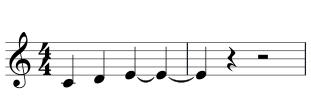
Page view is the ground truth for how the music looks: the same document through Verovio’s page layout, with the title, real spanning slurs, and measure numbers. When something looks odd in edit view, check page view before believing it.
What battuta is not
Section titled “What battuta is not”It is not an engraver, and this is a deliberate boundary rather than a missing feature. battuta has no spacing controls, no beam-angle editor, no drag-a-note handles, and no page-layout panel. Notation appearance is Verovio’s job; if a rendering is wrong, the fix is in the MEI or in Verovio’s options, never in a hand-nudged position.
It is also not a DAW. Playback exists so you can audition what you just edited — and to check that the form you notated actually plays the way you meant it.