Selecting music
battuta has two selection shapes, and they are for different jobs.
Event runs — red
Section titled “Event runs — red”A run is an ordered stretch of events inside one voice.
- shift-click from the caret to another note in the same voice.
- shift + ← / → extends note by note, across barlines.
Runs are what you want for anything that applies to notes: transposing, accidentals, articulations, slurs, ties, hairpins, tuplets, pedal.

Block selections — green
Section titled “Block selections — green”A block is a rectangle in the grid of measures × staves — the spreadsheet model, where measures are rows and staves are columns.
Drag across the score: as soon as the pointer leaves the measure or staff it started in, the drag becomes a block. Release to keep it.

Blocks are what you want for anything that applies to regions: copy and paste, repeat barlines, voltas, reflection, inserting or deleting measures.
One selection, every action
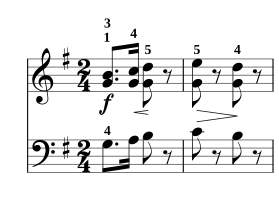
Section titled “One selection, every action”You don’t have to remember which shape an action wants. Whichever selection exists, battuta derives what the action needs from it:
| You have | An action that works on notes | An action that works on measures |
|---|---|---|
| A shift-run | uses the run directly | uses the measures the run spans |
| A single-staff block | uses the run of events inside it | uses the block directly |
| A multi-staff block | covers every event in it (transpose, accidentals) | uses the block directly |
So r toggles repeat barlines around the measures your shift-run touches, and ctrl + c on a run copies that run’s whole measure span. Where a span needs to start and end on notes — a slur, a hairpin, a tie chain — rests at the edges of the selection are trimmed so the endpoints land on real notes.
Endpoint pairs across staves
Section titled “Endpoint pairs across staves”A run cannot span two staves, so shift-clicking from one staff to another selects an endpoint pair: just the two notes you clicked. That is exactly what the spans which legitimately cross staves need — a cross-staff slur or hairpin — and battuta writes them with both staff numbers.
Actions that genuinely require one voice (tie chains, the grace-note pair) refuse an endpoint pair, and say so.
What a selection enables
Section titled “What a selection enables”| Selection | Then press |
|---|---|
| A run of notes | shift + s slur · t tie chain · p hairpin · shift + p pedal · shift + t tuplet |
| Two notes, different pitches | m grace-note cycle |
| Any notes | alt + ↑ / ↓ transpose · s v n accidentals · Delete to rests |
| A block of measures | ctrl + c copy · ctrl + v paste · r repeat barlines · shift + 1…9 voltas · shift + r reflection · +m −m ⧉m |
- Arranging — what blocks are really for.
- Marks and expression — what runs are really for.