
A tour of the window
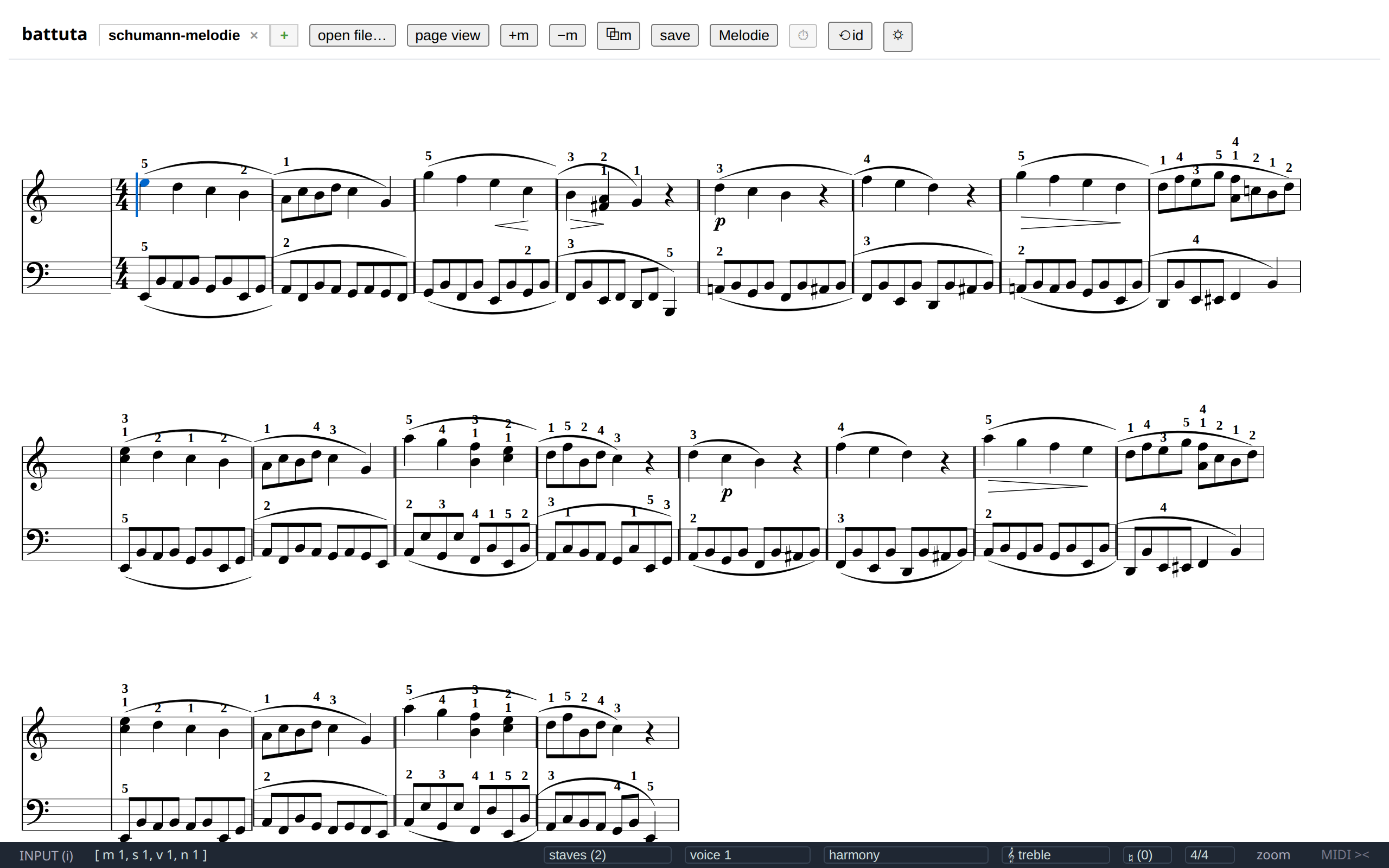
battuta has three bands: a header pinned at the top, the score in the middle, and a status bar fixed at the bottom. Nothing is hidden in menus — if a control exists, it is on screen.
The header
Section titled “The header”
| Control | What it does |
|---|---|
| tabs | One per open score. A trailing * means unsaved changes; × closes the tab. Undoing back to the saved state clears the star. |
| + | A fresh blank score: one treble staff, 4/4, four empty measures, named untitled-1, -2, … |
| open file… | The system open dialog, starting in the folder you last used. |
| page view / edit view | Switches between the two renderings — see The two views. |
| +m −m ⧉m | Insert, delete, duplicate measures at the caret or over the selected block. Same as numpad + − *. |
| save | Saves to the score’s own path, or opens save-as if it has none. |
| title | Inline editor for the score title; the button relabels itself to the current title. Page view prints it. |
| ⏱ | Shows or hides the performance numbers (render timings, per-tile milliseconds). Off by default. |
| ⟲id | Regenerates every xml:id in the document and rewrites all references to follow — the repair for files that accumulated duplicate ids. One undo step. |
| 🌣 | The shortcut editor: every action, its keys, and the rebinding UI. |
In page view the header also grows the player: ▶ / ⏸, ⏹, a tempo
select, a clickable progress bar and a mm:ss / mm:ss readout. See
Playback.
The score area
Section titled “The score area”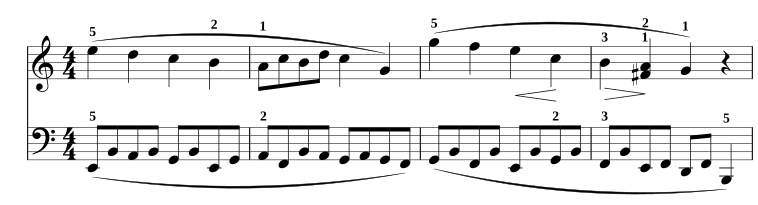
Clicking a note puts the caret on it. Dragging across measures or staves paints a block. Nothing you click ever changes the notation — the rendering is read-only, and all interaction happens on an overlay above it.
The view follows the caret: when navigation or note entry pushes the caret off screen, the score scrolls it back into the middle. Re-layout and zoom never yank the view.
The two views
Section titled “The two views”Edit view (the default) renders each measure as its own small engraving and flows those tiles into rows like words in a paragraph. That is what makes editing instant: a keystroke re-renders one tile, not the score. The cost is cosmetic — spacing is justified per measure rather than across the page, and slurs or ties that cross a tile edge are drawn as broken continuations, the same convention as a system break.
Page view renders the whole document through Verovio’s normal page layout: proper spacing, real spanning slurs, the printed title, measure numbers at system starts. Use it to proofread, and to play the score. The caret and selection survive the switch, because both are stored as positions in the document, never as pixels.
The status bar
Section titled “The status bar”
Left side:
INPUT (i)— click it to toggle note input. While input is on it turns green and reads the current duration, its note glyph, and the digit key that selects it:1/8 ♪ (4).- caret readout —
[ m 10, s 2, v 1, n 6 ]: measure, staff, voice, and index of the event under the caret, all counted from 1.
Right side, all showing the context in force at the caret and applying their change at the caret’s measure:
- staves — the staff count, plus add staff below and remove caret staff.
- voices — the caret’s voice, with switch / add / remove.
- harmony — opens a chord-symbol or Roman-numeral lane.
- clef — per staff. Stepping onto a tenor-clef staff flips the indicator.
- key and meter — score-wide from the caret’s measure onward.
- zoom — click for + / − / reset; 50 %–250 % in 25 % steps.
- MIDI —
MIDI ><grey when nothing is connected, greenMIDI <>with a device count when a controller is. Click it to list the devices.
Messages
Section titled “Messages”Errors, confirmations and refusals appear as toasts in the bottom-right
corner. They fade on their own; the × on the left closes one early, and the
text is selectable so an error message can be copied into a bug report.

A refusal is information, not a failure — battuta says no to edits that would produce a measure that doesn’t add up, and the toast names the reason. See Why an edit gets refused.