Rhythm
Everything on this page obeys the same rule: the measure keeps adding up. That is what makes these operations safe to lean on — and what makes them refuse occasionally.
Changing a note’s duration
Section titled “Changing a note’s duration”alt + → lengthens the event under the caret one step, alt + ← shortens it. Lengthening takes the time from what follows; shortening gives it back as rests.
Compare with the duration digits, which only set what the next note will be. The target here is the same as the dot’s: the note you just entered while in input mode, otherwise the note under the caret.
Merge and split
Section titled “Merge and split”| Keys | Action | Applies |
|---|---|---|
| m | merge with next · grace cycle (2 pitches) | any time |
| x | split in half | any time |
m merges the caret’s event with the next one. They have to be mergeable: the same pitch (or two rests, or two chords with identical pitches), adjacent in the same container, and their sum has to be writable as a single note.
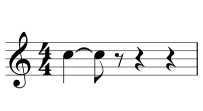
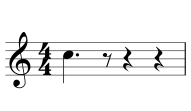
A quarter plus an eighth is a dotted quarter, so it merges. A half plus an eighth has no single notehead, so it is refused — use a tie for that.
x splits any note, rest or chord in half, in place: a half note becomes two quarters, a dotted half becomes two dotted quarters, ties are redistributed across the halves.
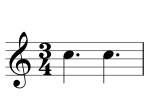
Whole-measure rests join in, which is what makes a freshly inserted measure workable: x on a whole-measure rest gives two half-measure rest runs (meter-aware — in 6/8 that’s two dotted quarters), and merging rests back up to a full measure collapses them into a whole-measure rest again.
Tuplets
Section titled “Tuplets”Select exactly 3 notes and press shift + t for a triplet (3:2), or 6 for a sextuplet (6:4).
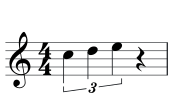
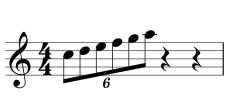
The run shrinks to its tuplet duration and the time it frees becomes rests immediately after — which is why the measure stays legal without you doing anything. Select notes inside a tuplet and press the same keys to unwrap it; the rests are consumed back and you get the original bytes.
It refuses, with a reason, when: the count isn’t 3 or 6, the notes aren’t consecutive, the durations are mixed in a way whose freed time can’t be written as rests, or you try to unwrap a tuplet whose rests are gone.
Auto-beaming
Section titled “Auto-beaming”alt + b beams the caret’s measure — or every measure your selection touches, in one press.
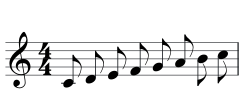
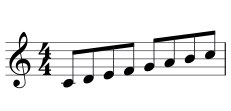
The policy is simple and meter-independent: no beam spans more than half the measure, the note’s onset decides which half it belongs to, and rests or notes longer than an eighth break a group. A group of one stays unbeamed. Running it again is harmless — existing beams are lifted and regrouped.
Beams are formatting
Section titled “Beams are formatting”Beams are a presentation decision, and rhythm edits dissolve them. Note entry, duration changes, merge, split and delete all un-beam the measure first, so that entry never gets stuck at a beam boundary and no broken beams survive an edit. Re-beam with alt + b once the rhythm has settled.
The un-beam travels with the edit as one undo step, and if the edit itself is refused, the un-beam rolls back too.
Grace notes
Section titled “Grace notes”Select two adjacent notes of different pitches and press m: the first becomes a grace note, cycling acciaccatura (slashed) → appoggiatura → none.
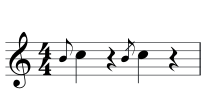
Its written time folds into the main note — like a merge — and is handed back on the way out of the cycle. Two notes of the same pitch merge instead, as usual. Non-adjacent pairs and sums that can’t be folded are refused.
Simile and measure repeats
Section titled “Simile and measure repeats”| Keys | Action | Applies |
|---|---|---|
| ' | simile slash (one beat) | any time |
| " | measure repeat % → %% | any time |
One beat: the unshifted key replaces the beat at the caret with a simile slash, consuming the events inside that beat exactly the way overwrite entry does. Press it again and the slash becomes a beat rest. It refuses to cross the barline.
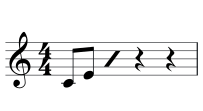
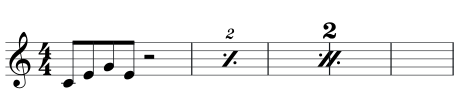
Whole measures: the shifted key cycles the caret measure’s voice through
content → % (repeat the previous measure) → %% (repeat the previous two,
claiming the next measure as well) → empty. Your original content comes back
with undo.
All rhythm bindings
Section titled “All rhythm bindings”| Keys | Action | Applies |
|---|---|---|
| m | merge with next · grace cycle (2 pitches) | any time |
| x | split in half | any time |
| shift + t | tuplet 3:2 / 6:4 (selection) | any time |
| shift + r | reflection cycle: inversion → retrograde → retr. inversion → back | block selection |
| alt + b | auto-beam measure | any time |
| ⌥←/→ | shorten / lengthen duration | any timefixed |