Playback
Playback in battuta is a checking tool, not a performance engine. It answers two questions: did I write the notes I meant? and does the form I notated actually play that way?
The player
Section titled “The player”Switch to page view — the controls appear next to the view toggle.

| Control | Does |
|---|---|
| ▶ / ⏸ | Play or pause from the current position |
| ⏹ | Stop and clear the highlight |
| tempo | 0.5×, 0.75×, 1×, 1.25×, 1.5×, 2× — applies live, and is remembered |
| progress bar | Click anywhere to seek; the readout shows elapsed / total at the chosen tempo |
The note being sounded lights up as it plays, and the view scrolls when the playing measure leaves the window. Audio and highlight come from one timeline, so they cannot drift apart.
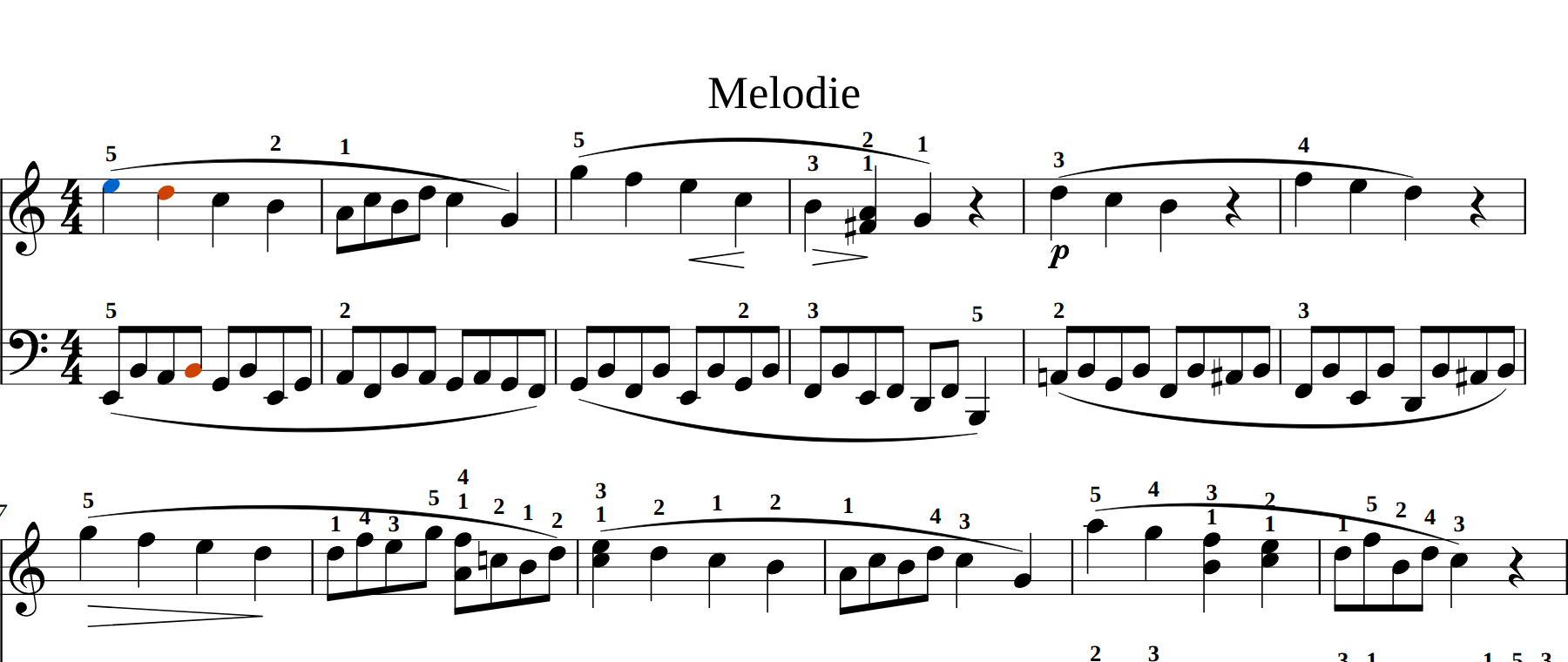
Sound is a sampled piano — a subset of the Salamander piano bundled inside the application. No network request, no CDN, nothing to configure.
What you hear reflects what you wrote
Section titled “What you hear reflects what you wrote”Playback reads the document, not just the pitches:
- Ties are held. A tie chain — including one that crosses barlines and one that spans repeated passes — sounds as a single attack for its full summed length.
- Articulations shape the release. Tenuto and notes under a slur or phrase mark sound their full value, staccato about half, staccatissimo about a third. An explicit articulation beats the slur it sits under.
- Unmarked notes detach slightly (about 90 % of their value), so legato is audible by contrast rather than being the default everywhere.
- Accidentals, key signatures and measure accidentals resolve to real sounding pitch, because Verovio resolves them before the note reaches the sampler.
Repeats, voltas and jumps
Section titled “Repeats, voltas and jumps”The player takes the form: repeat barlines, volta sets, and one dal-segno or da-capo jump with fine and To Coda respected. Repeated passes highlight the notes you actually wrote, not copies of them.
The details of what is and isn’t followed are on Repeats and form.
Limits worth knowing
Section titled “Limits worth knowing”- Playback lives in page view only. Edit view has no player.
- There is no selection-range playback yet, no metronome, no per-staff mute, and no tempo marks from the score — the tempo select is the only tempo.
- Dynamics and hairpins are notated but not yet performed as volume changes.